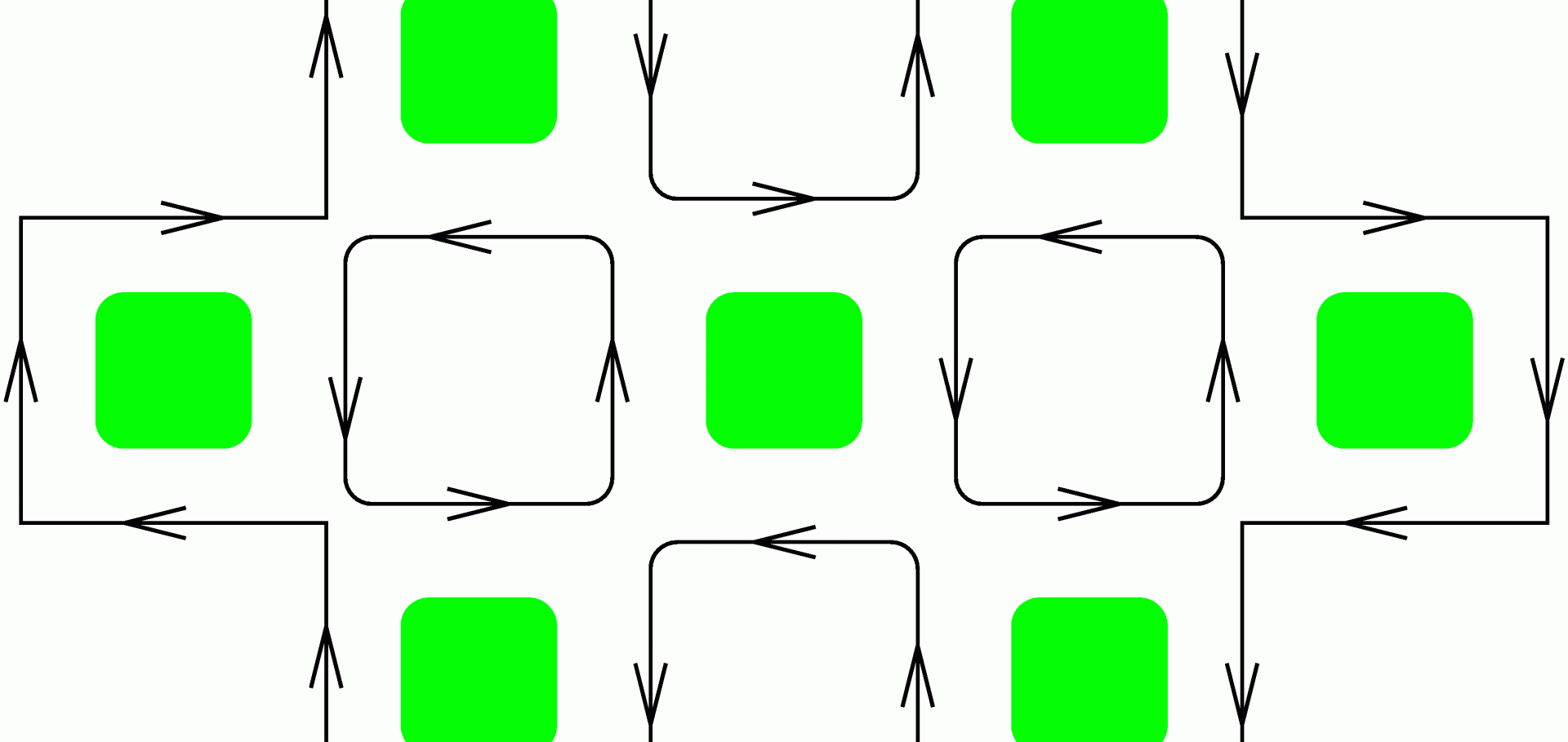
Universality class of the two-dimensional polymer collapse transition.

Physical review. E 93:5 (2016) 052502-052502

Abstract:

The nature of the θ point for a polymer in two dimensions has long been debated, with a variety of candidates put forward for the critical exponents. This includes those derived by Duplantier and Saleur for an exactly solvable model. We use a representation of the problem via the CP^{N-1}σ model in the limit N→1 to determine the stability of this critical point. First we prove that the Duplantier-Saleur (DS) critical exponents are robust, so long as the polymer does not cross itself: They can arise in a generic lattice model and do not require fine-tuning. This resolves a longstanding theoretical question. We also address an apparent paradox: Two different lattice models, apparently both in the DS universality class, show different numbers of relevant perturbations, apparently leading to contradictory conclusions about the stability of the DS exponents. We explain this in terms of subtle differences between the two models, one of which is fine-tuned (and not strictly in the DS universality class). Next we allow the polymer to cross itself, as appropriate, e.g., to the quasi-two-dimensional case. This introduces an additional independent relevant perturbation, so we do not expect the DS exponents to apply. The exponents in the case with crossings will be those of the generic tricritical O(n) model at n=0 and different from the case without crossings. We also discuss interesting features of the operator content of the CP^{N-1} model. Simple geometrical arguments show that two operators in this field theory, with very different symmetry properties, have the same scaling dimension for any value of N (or, equivalently, any value of the loop fugacity). Also we argue that for any value of N the CP^{N-1} model has a marginal odd-parity operator that is related to the winding angle.

Active turbulence in active nematics

(2016)

Authors:

Sumesh P Thampi, Julia M Yeomans

Quantum quenches to the attractive one-dimensional Bose gas: exact results

(2016)

Authors:

Lorenzo Piroli, Pasquale Calabrese, Fabian HL Essler

Strong Peak in $T_c$ of Sr$_2$RuO$_4$ Under Uniaxial Pressure

(2016)

Authors:

Alexander Steppke, Lishan Zhao, Mark E Barber, Thomas Scaffidi, Fabian Jerzembeck, Helge Rosner, Alexandra S Gibbs, Yoshiteru Maeno, Steven H Simon, Andrew P Mackenzie, Clifford W Hicks

Particle-hole symmetry, many-body localization, and topological edge modes

Physical Review B 93:13 (2016)

Authors:

R Vasseur, AJ Friedman, SA Parameswaran, AC Potter

Abstract:

© 2016 American Physical Society. We study the excited states of interacting fermions in one dimension with particle-hole symmetric disorder (equivalently, random-bond XXZ chains) using a combination of renormalization group methods and exact diagonalization. Absent interactions, the entire many-body spectrum exhibits infinite-randomness quantum critical behavior with highly degenerate excited states. We show that though interactions are an irrelevant perturbation in the ground state, they drastically affect the structure of excited states: Even arbitrarily weak interactions split the degeneracies in favor of thermalization (weak disorder) or spontaneously broken particle-hole symmetry, driving the system into a many-body localized spin glass phase (strong disorder). In both cases, the quantum critical properties of the noninteracting model are destroyed, either by thermal decoherence or spontaneous symmetry breaking. This system then has the interesting and counterintuitive property that edges of the many-body spectrum are less localized than the center of the spectrum. We argue that our results rule out the existence of certain excited state symmetry-protected topological orders.