

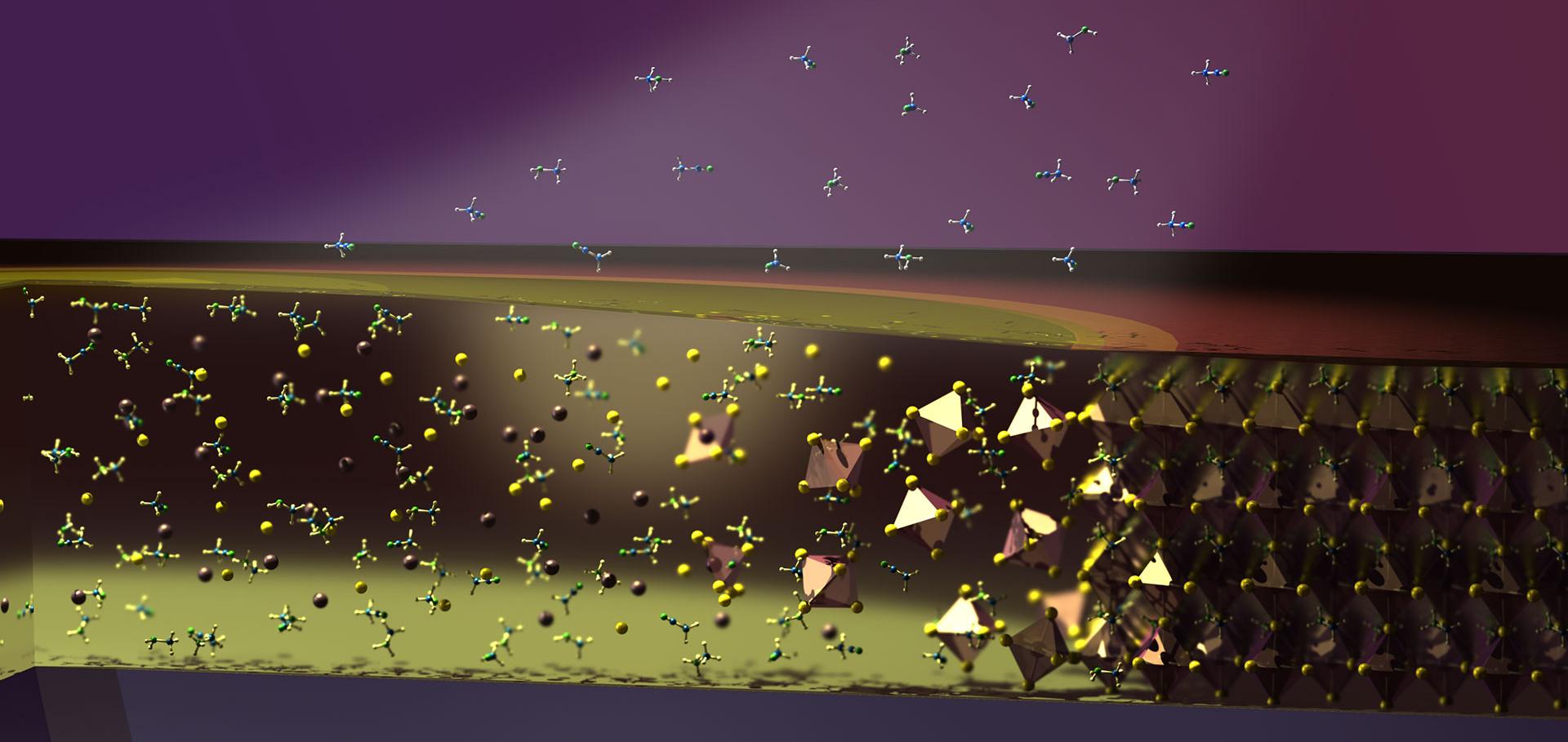
Metal Halide Perovskite Polycrystalline Films Exhibiting Properties of Single Crystals
Joule Elsevier 1:1 (2017) 155-167
Efficient and stable perovskite solar cells using molybdenum tris(dithiolene)s as p-dopants for spiro-OMeTAD
ACS Energy Letters American Chemical Society 2:9 (2017) 2044-2050
Abstract:
Metal halide perovskite solar cells have now reached efficiencies of over 22%. To date, the most efficient perovskite solar cells have the n-i-p device architecture and use 2,2′,7,7′-tetrakis(N,N′-di-p-methoxyphenylamine)-9,9′-spirobifluorene or poly(triarylamine) as the hole transport material (HTM), which are typically doped with lithium bis((trifluomethyl)sulfonyl)amide (Li-TFSI). Li-TFSI is hygroscopic and detrimental to the long-term performance of the solar cells, limiting its practical use. In this work, we successfully replace Li-TFSI by molybdenum tris(1-(methoxycarbonyl)-2-(trifluoromethyl)ethane-1,2-dithiolene), Mo(tfd-CO2Me)3, or molybdenum tris(1-(trifluoroacetyl)-2-(trifluoromethyl)ethane-1,2-dithiolene), Mo(tfd-COCF3)3. With these two dopants, we achieve stabilized power conversion efficiencies up to 16.7% and 15.7% with average efficiencies of 14.8% ± 1.1% and 14.4% ± 1.2%, respectively. Moreover, we observe a significant enhancement of the long-term stability of perovskite solar cells under 85 °C thermal stressing in air.Crystallization kinetics and morphology control of formamidinium-cesium mixed-cation lead mixed-halide perovskite via tunability of the colloidal precursor solution
Advanced Materials Wiley 29:29 (2017) 1-8
Abstract:
The meteoric rise of the field of perovskite solar cells has been fueled by the ease with which a wide range of high-quality materials can be fabricated via simple solution processing methods. However, to date, little effort has been devoted to understanding the precursor solutions, and the role of additives such as hydrohalic acids upon film crystallization and final optoelectronic quality. Here, a direct link between the colloids concentration present in the [HC(NH2 )2 ]0.83 Cs0.17 Pb(Br0.2 I0.8 )3 precursor solution and the nucleation and growth stages of the thin film formation is established. Using dynamic light scattering analysis, the dissolution of colloids over a time span triggered by the addition of hydrohalic acids is monitored. These colloids appear to provide nucleation sites for the perovskite crystallization, which critically impacts morphology, crystal quality, and optoelectronic properties. Via 2D X-ray diffraction, highly ordered and textured crystals for films prepared from solutions with lower colloidal concentrations are observed. This increase in material quality allows for a reduction in microstrain along with a twofold increase in charge-carrier mobilities leading to values exceeding 20 cm(2) V(-1) s(-1) . Using a solution with an optimized colloidal concentration, devices that reach current-voltage measured power conversion efficiency of 18.8% and stabilized efficiency of 17.9% are fabricated.(Invited) Polymer Wrapped Carbon Nanotubes As Highly Effective Hole Transporting Layers for New Perovskite and Quantum Dot Photovoltaic Devices
ECS Meeting Abstracts The Electrochemical Society MA2017-01:7 (2017) 586-586
Mechanism for rapid growth of organic-inorganic halide perovskite crystals
Nature Communications Nature Publishing Group 7 (2016) 13303