

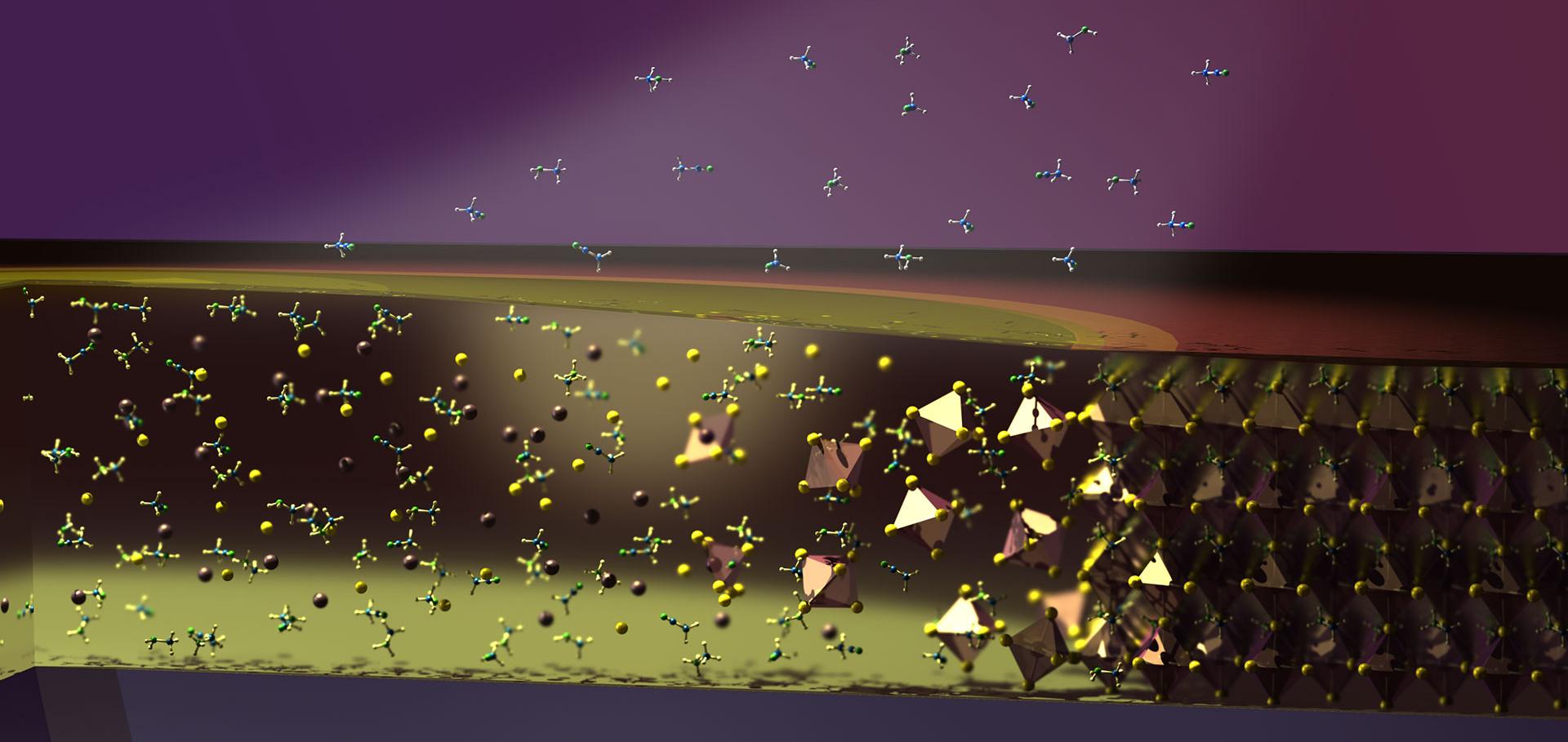
A low viscosity, low boiling point, clean solvent system for the rapid crystallisation of highly specular perovskite films
Energy and Environmental Science Royal Society of Chemistry 10:1 (2016) 145-152
Abstract:
Perovskite-based photovoltaics have, in recent years, become poised to revolutionise the solar industry. While there have been many approaches taken to the deposition of this material, one-step spin-coating remains the simplest and most widely used method in research laboratories. Although spin-coating is not recognised as the ideal manufacturing methodology, it represents a starting point from which more scalable deposition methods, such as slot-dye coating or ink-jet printing can be developed. Here, we introduce a new, low-boiling point, low viscosity solvent system that enables rapid, room temperature crystallisation of methylammonium lead triiodide perovskite films, without the use of strongly coordinating aprotic solvents. Through the use of this solvent, we produce dense, pinhole free films with uniform coverage, high specularity, and enhanced optoelectronic properties. We fabricate devices and achieve stabilised power conversion efficiencies of over 18% for films which have been annealed at 100 °C, and over 17% for films which have been dried under vacuum and have undergone no thermal processing. This deposition technique allows uniform coating on substrate areas of up to 125 cm2, showing tremendous promise for the fabrication of large area, high efficiency, solution processed devices, and represents a critical step towards industrial upscaling and large area printing of perovskite solar cells.Investigating the role of 4-tert butylpyridine in perovskite solar cells
Advanced Energy Materials Wiley 7:1 (2016) 1601079
Abstract:
The majority of hole‐transporting layers used in n‐i‐p perovskite solar cells contain 4‐tert butylpyridine (tBP). High power‐conversion efficiencies and, in particular, good steady‐state performance appears to be contingent on the inclusion of this additive. On the quest to improve the steady state efficiencies of the carbon nanotube‐based hole‐transporter system, this study has found that the presence of tBP results in an extraordinary improvement in the performance of these devices. By deconstructing a prototypical device and investigating the effect of tBP on each individual layer, the results of this study indicate that this performance enhancement must be due to a direct chemical interaction between tBP and the perovskite material. This study proposes that tBP serves to p‐dope the perovskite layer and investigates this theory with poling and work function measurements.Hydrophobic Organic Hole Transporters for Improved Moisture Resistance in Metal Halide Perovskite Solar Cells
ACS Applied Materials & Interfaces American Chemical Society (ACS) 8:9 (2016) 5981-5989
Enhanced optoelectronic quality of perovskite thin films with hypophosphorous acid for planar heterojunction solar cells
(2015)
Abstract:
Solution-processed metal halide perovskite semiconductors, such as CH3NH3PbI3, have exhibited remarkable performance in solar cells, despite having non-negligible density of defect states. A likely candidate is halide vacancies within the perovskite crystals, or the presence of metallic lead, both generated due to the imbalanced I/Pb stoichiometry which could evolve during crystallization. Herein, we show that the addition of hypophosphorous acid (HPA) in the precursor solution can significantly improve the film quality, both electronically and topologically, and enhance the photoluminescence intensity, which leads to more efficient and reproducible photovoltaic devices. We demonstrate that the HPA can reduce the oxidized I2 back into I(-), and our results indicate that this facilitates an improved stoichiometry in the perovskite crystal and a reduced density of metallic lead.Enhanced optoelectronic quality of perovskite thin films with hypophosphorous acid for planar heterojunction solar cells
Nature Communications Nature Research 6:1 (2015) 10030