


Resolving Nanoscale Heterogeneities in Lead Halide Perovskites Through Low‐Dose Concurrent 4D‐STEM‐EDX Mapping
Advanced Materials Wiley (2026) e74382
Abstract:
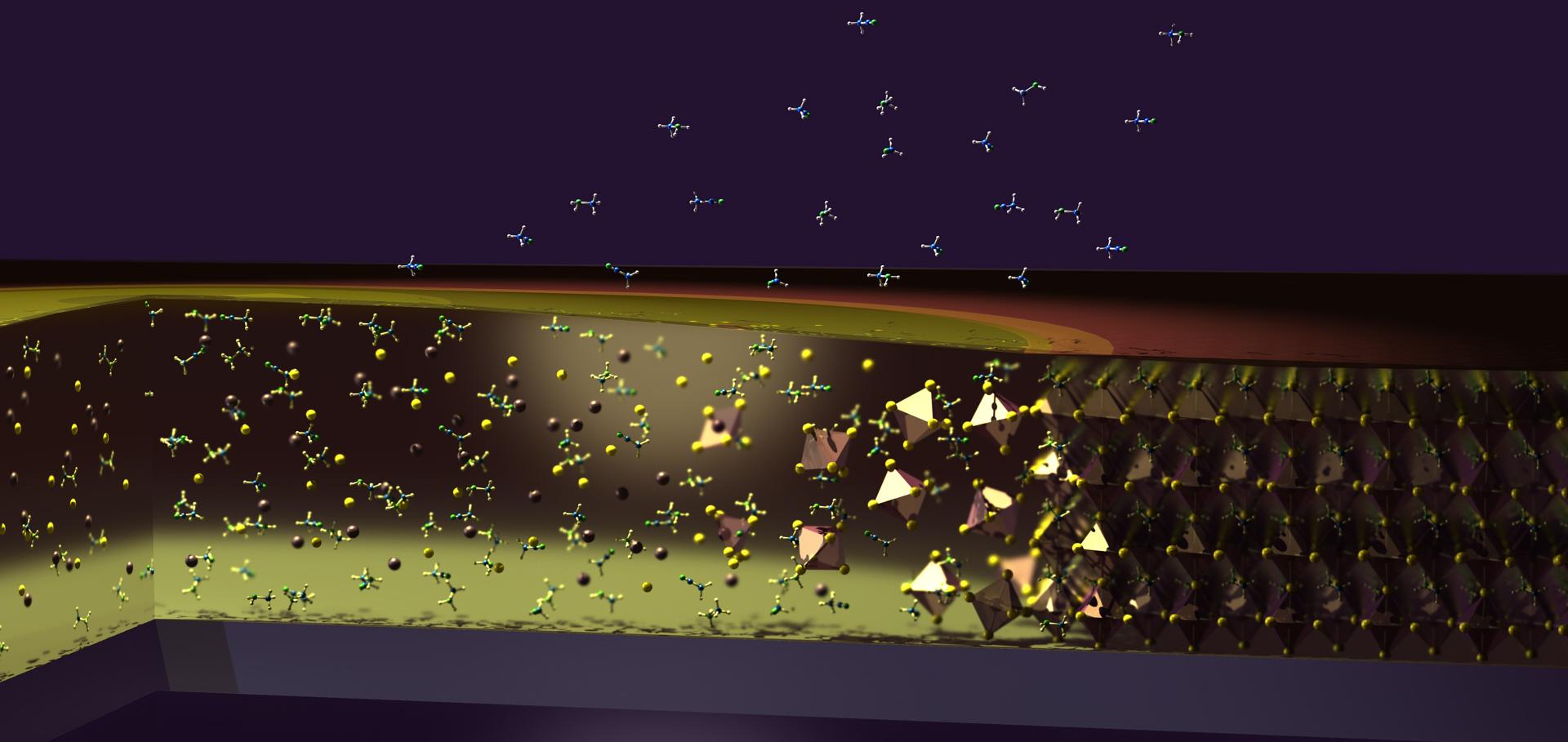
Mixed-cation lead mixed-halide perovskites are promising materials for applications in photovoltaics; however, it has been suggested that they exhibit instabilities linked to nanoscale heterogeneity. Directly probing the origins of this heterogeneity requires characterization with nanoscale spatial resolution, making transmission electron microscopy (TEM) an essential tool. However, characterizing these materials is challenging due to their extreme sensitivity to electron irradiation. Here, we develop a low-dose, concurrent methodology using four-dimensional scanning transmission electron microscopy (4D-STEM) and energy-dispersive x-ray spectroscopy (EDX) in order to map both the chemical and structural architecture of a (FA0.83Cs0.17)Pb(I0.8Br0.2)3 perovskite film without inducing damage. Our correlative analysis reveals a complex mosaic of coexisting crystal structures in this state-of-the-art LHP film. We establish a direct link between local chemical composition and crystal structure, showing that the formation of undesirable, photovoltaically inactive hexagonal polytypes is predominantly driven by local deficiencies in the stabilizing cesium cation. These findings provide crucial insight into one of the fundamental origins of structural instabilities in mixed composition perovskite thin-films, suggesting that achieving long-term device performance requires the development of fabrication routes that ensure compositional homogeneity at the nanoscale.Tracking the Breakdown of Quantum Confinement during Structural Degradation of FAPbI 3
The Journal of Physical Chemistry Letters American Chemical Society 17:23 (2026) 6566-6573
Abstract:
Bulk formamidinium lead triiodide (FAPbI3) films host spontaneously formed quantum-confined (QC) domains, but their structural origin remains unclear. Using controlled material degradation in humid air as a dynamic lattice perturbation, we track the evolution of QC features in thin-film absorption of FAPbI3. With aging, above-bandgap QC features redshift and diminish, indicating weakened electronic confinement. Concurrently, X-ray diffraction reveals that breakdown of α-phase connectivity coincides with the loss of short-range higher-order hexagonal (nH, n > 2) polytypes as the material converts to the 2H δ-phase. Such polytypic nanodomains may generate peaked absorption features by forming higher-energy barriers confining charge carriers within α-FAPbI3 or by introducing distinct electronic states associated with mixed octahedral connectivity. Progressive degradation dismantles this framework, causing the disappearance of the QC features. Our results identify the structural motifs underpinning QC effects and propose that controlling higher-order (n > 2) hexagonal polytypes offers a route to tuning quantum confinement in FAPbI3 films.Tackling Material Instabilities in Halide Perovskites: Kinetic Pathways and Nanoscale Mixing
Fundacio Scito (2026)
From precursor to performance: the impact of FAI impurities on halide perovskite thin films and devices
EES Solar Royal Society of Chemistry (2026)
Abstract:
While metal halide perovskites have yielded remarkable power conversion efficiencies in photovoltaic applications, uncertainty concerning their long-term stability remains a significant barrier to widespread deployment. Previous studies have demonstrated that trace impurities present in perovskite precursor materials can influence the crystallisation dynamics of perovskite thin-films and hence, affect crystal structure, film morphology and optoelectronic properties. However, the nature of the impurities in formamidinium iodide (FAI) and their effect(s) on film quality and device performance remain underexplored. In this work, we carry out a detailed analysis of the impurities present in commonly used commercial FAI sources, and probe their impact on the composition, structure, and optoelectronic quality of the resulting perovskite thin-films and devices. We find that while some FAI impurities can improve the optoelectronic properties of solution-processed perovskite thin-films, in vapour-processed films, their presence alters the sublimation behaviour of FAI, favouring irreversible degradation pathways which lead to the formation of sym-triazine. While sym-triazine does not directly incorporate into the perovskite films, the impurity-driven variation in sublimation behaviour results in films which can deviate from the target stoichiometry, even under otherwise optimised conditions; and thus, do not fully convert into the desired photoactive phase, eventually causing poor material stability. Our results highlight the importance of understanding and controlling impurity concentrations in perovskite precursor materials as a route to enhancing both performance and process reproducibility in perovskite solar cells.Crystal-facet-directed all vacuum-deposited perovskite solar cells
Nature Materials Springer Nature (2026)