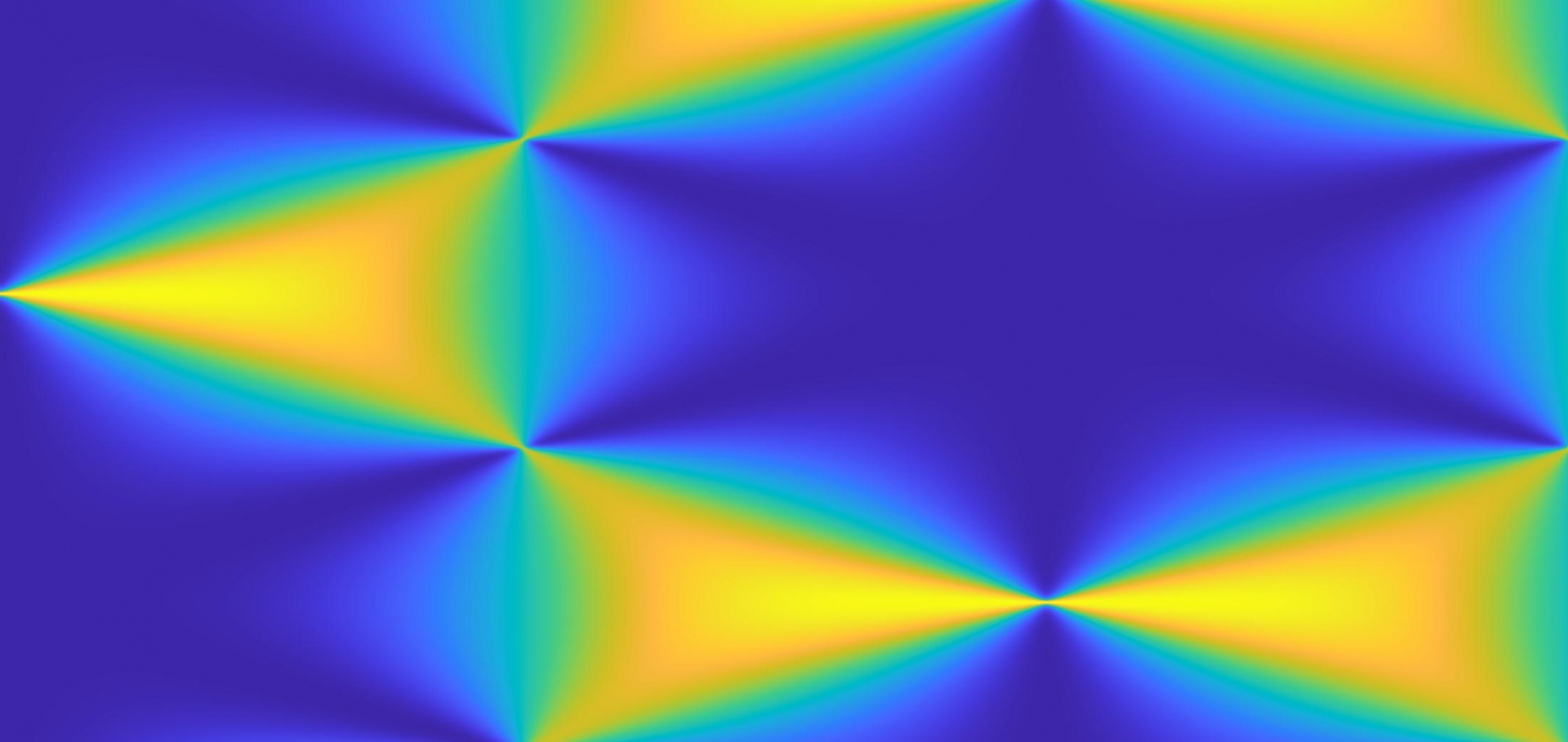
Flexoelectric surface switching of bistable nematic devices

(2001)

Authors:

Colin Denniston, JM Yeomans

Casimir torques between anisotropic boundaries in nematic liquid crystals

Physical Review E - Statistical, Nonlinear, and Soft Matter Physics 64:2 I (2001) 227011-227014

Authors:

R Golestanian, A Ajdari, JB Fournier

Abstract:

The torque induced between bounding surfaces in nematic liquid crystals due to thermal fluctuations was reported. The existence of Casimir torque due to anisotropy in the shape of the objects immersed in the complex fluid depended on the relative orientation of these objects. The torques were calculated for a simple geometry in the absence of elastic effects. These calculations suggested a direct measure of the torque exerted between two plates at fixed separation and a measure of force as a function of separation for plates at various angles.

Many-body interactions and correlations in coarse-grained descriptions of polymer solutions

Physical Review E - Statistical, Nonlinear, and Soft Matter Physics 64:2 I (2001) 218011-2180112

Authors:

PG Bolhuis, AA Louis, JP Hansen

Abstract:

Many-body interactions and correlations in coarse-grained descriptions of polymer solutions were studied using Monte Carlo simulations. The effective density dependent two-body potentials that exactly reproduced the pair-correlations between the center of mass (c.m.) of the self avoiding walk polymers were also studied. The results showed that a pair potential cannot simultaneously reproduce the two- and three-body correlations in a system with many-body interactions.

Casimir torques between anisotropic boundaries in nematic liquid crystals.

Phys Rev E Stat Nonlin Soft Matter Phys 64:2 Pt 1 (2001) 022701

Authors:

R Golestanian, A Ajdari, JB Fournier

Abstract:

Fluctuation-induced interactions between anisotropic objects immersed in a nematic liquid crystal are shown to depend on the relative orientation of these objects. The resulting long-range "Casimir" torques are explicitly calculated for a simple geometry where elastic effects are absent. Our study generalizes previous discussions restricted to the case of isotropic walls, and leads to new proposals for experimental tests of Casimir forces and torques in nematics.

Many-body interactions and correlations in coarse-grained descriptions of polymer solutions.

Phys Rev E Stat Nonlin Soft Matter Phys 64:2 Pt 1 (2001) 021801

Authors:

PG Bolhuis, AA Louis, JP Hansen

Abstract:

We calculate the two-, three-, four-, and five-body (state-independent) effective potentials between the centers of mass (c.m.'s) of self-avoiding walk polymers by Monte Carlo simulations. For full overlap, these coarse-grained n-body interactions oscillate in sign as (-1)(n), and decrease in absolute magnitude with increasing n. We find semiquantitative agreement with a scaling theory, and use this to discuss how the coarse-grained free energy converges when expanded to arbitrary order in the many-body potentials. We also derive effective density dependent two-body potentials that exactly reproduce the pair-correlations between the c.m. of the self avoiding walk polymers. The density dependence of these pair potentials can be largely understood from the effects of the density independent three-body potential. Triplet correlations between the c.m. of the polymers are surprisingly well, but not exactly, described by our coarse-grained effective pair potential picture. In fact, we demonstrate that a pair potential cannot simultaneously reproduce the two- and three-body correlations in a system with many-body interactions. However, the deviations that do occur in our system are very small, and can be explained by the direct influence of three-body potentials.