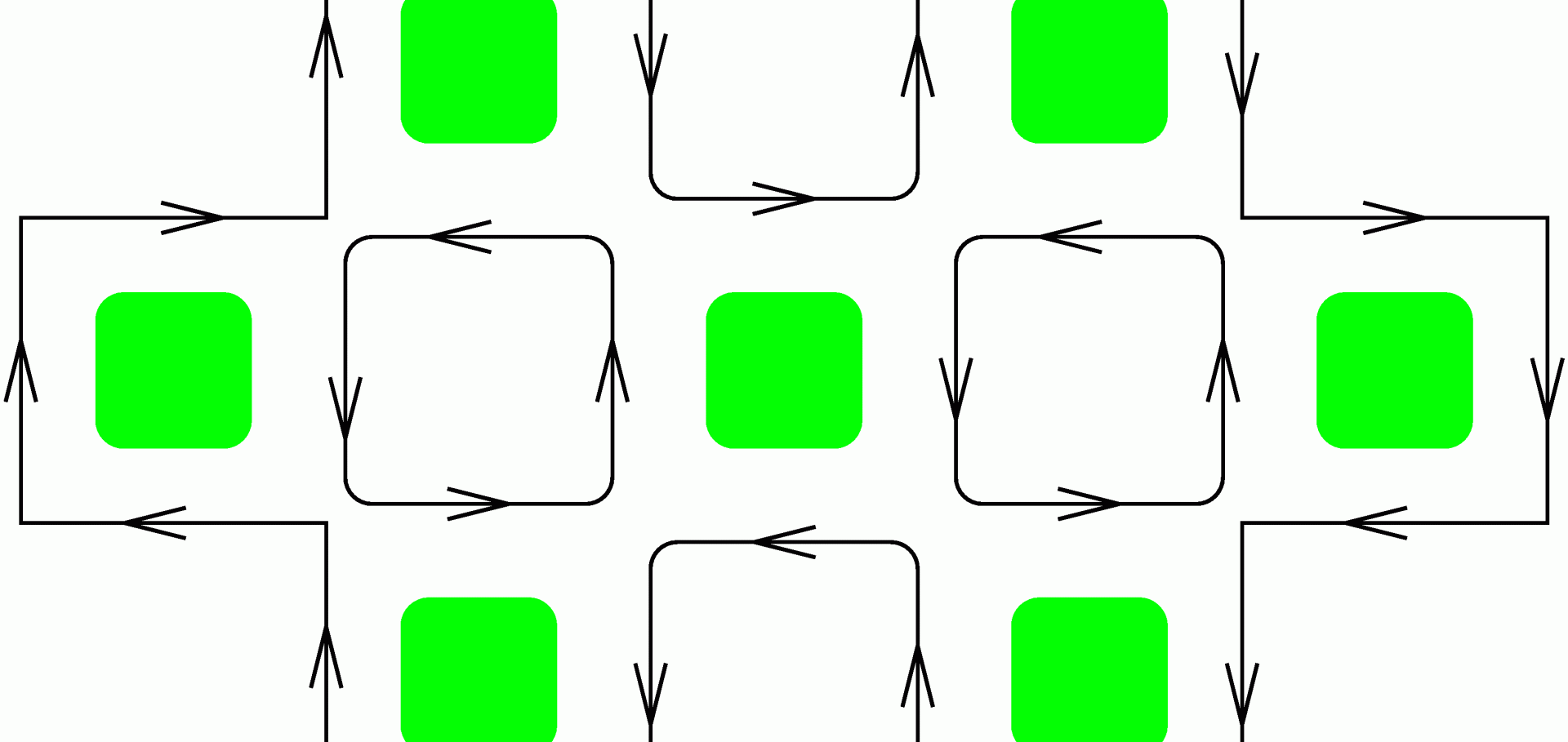
Collective rotational motion of freely-expanding T84 epithelial cell colonies

(2022)

Authors:

Flora Ascione, Sergio Caserta, Speranza Esposito, Valeria Rachela Villella, Luigi Maiuri, Mehrana R Nejad, Amin Doostmohammadi, Julia M Yeomans, Stefano Guido

The structure of genotype-phenotype maps makes fitness landscapes navigable

Nature Ecology and Evolution Springer Nature 6:11 (2022) 1742-1752

Authors:

Sam F Greenbury, Ard A Louis, Sebastian E Ahnert

Abstract:

Fitness landscapes are often described in terms of 'peaks' and 'valleys', indicating an intuitive low-dimensional landscape of the kind encountered in everyday experience. The space of genotypes, however, is extremely high dimensional, which results in counter-intuitive structural properties of genotype-phenotype maps. Here we show that these properties, such as the presence of pervasive neutral networks, make fitness landscapes navigable. For three biologically realistic genotype-phenotype map models-RNA secondary structure, protein tertiary structure and protein complexes-we find that, even under random fitness assignment, fitness maxima can be reached from almost any other phenotype without passing through fitness valleys. This in turn indicates that true fitness valleys are very rare. By considering evolutionary simulations between pairs of real examples of functional RNA sequences, we show that accessible paths are also likely to be used under evolutionary dynamics. Our findings have broad implications for the prediction of natural evolutionary outcomes and for directed evolution.

Optimal navigation of microswimmers in complex and noisy environments

New Journal of Physics IOP Publishing 24:9 (2022) 093037-093037

Authors:

Lorenzo Piro, Benoît Mahault, Ramin Golestanian

Abstract:

We analyze long-time correlated Brownian motion and scaled Brownian motion on the surface of the two dimensional sphere $\mathbb{S}^{2}$. Due to the geometric effects induced by the $\mathbb{S}^{2}$ curvature, such correlations collude with specific dynamics (\emph{navigation strategies}) on the manifold topology to originate rich transport properties. We focus our study to two classes of navigation strategies: One induced by the specific set of coordinates chosen for $\mathbb{S}^2$ which defines a fixed frame of reference; in particular, we chose the basis induced by spherical coordinates. We find that contrary to what occurs in the absence of correlations non-equilibrium stationary distributions are attained. We elucidate an analogy of our results with those observed of fractional Brownian motion in confined by reflecting walls in one and two dimensions. In contrast, when the navigation strategy chosen corresponds to a frame of reference moving with the particle as does the Frenet-Serret system, then the equilibrium uniform distribution on the sphere is attained. In both cases, the relaxation times towards the stationary distribution depend on the particular value of the Hurst parameter. We show that scaled Brownian motion on $\mathbb{S}^2$ is independent of the navigation strategy and we find a good agreement between the analytical calculations obtained from the solution of a time-dependent diffusion equation on $\mathbb{S}^{2}$ and the numerical results obtained from our method to generate ensemble of trajectories.Comment: The statistics of Fractional Brownian motion and of scaled Brownian motion are analyzed when motion is constrained to surface of a spher

Anomalous gapped boundaries between surface topological orders in higher-order topological insulators and superconductors with inversion symmetry

Physical Review B 106:12 (2022)

Authors:

Mh Li, T Neupert, Sa Parameswaran, A Tiwari

Abstract:

We show that the gapless boundary signatures - namely, chiral/helical hinge modes or localized zero modes - of three-dimensional higher-order topological insulators and superconductors with inversion symmetry can be gapped without symmetry breaking upon the introduction of non-Abelian surface topological order. In each case, the fractionalization pattern that appears on the surface is "anomalous"in the sense that it can be made consistent with symmetry only on the surface of a three-dimensional higher-order insulator/superconductor. Our results show that the interacting manifestation of higher-order topology is the appearance of "anomalous gapped boundaries"between distinct topological orders whose quasiparticles are related by inversion, possibly in conjunction with other protecting symmetries such as time-reversal symmetry and charge conservation.

Anomalous gapped boundaries between surface topological orders in higher-order topological insulators and superconductors with inversion symmetry

Physical Review B American Physical Society 106:12 (2022) 125121

Authors:

Ming-Hao Li, Titus Neupert, SA Parameswaran, Apoorv Tiwari

Abstract:

We show that the gapless boundary signatures—namely, chiral/helical hinge modes or localized zero modes—of three-dimensional higher-order topological insulators and superconductors with inversion symmetry can be gapped without symmetry breaking upon the introduction of non-Abelian surface topological order. In each case, the fractionalization pattern that appears on the surface is “anomalous” in the sense that it can be made consistent with symmetry only on the surface of a three-dimensional higher-order insulator/superconductor. Our results show that the interacting manifestation of higher-order topology is the appearance of “anomalous gapped boundaries” between distinct topological orders whose quasiparticles are related by inversion, possibly in conjunction with other protecting symmetries such as time-reversal symmetry and charge conservation.