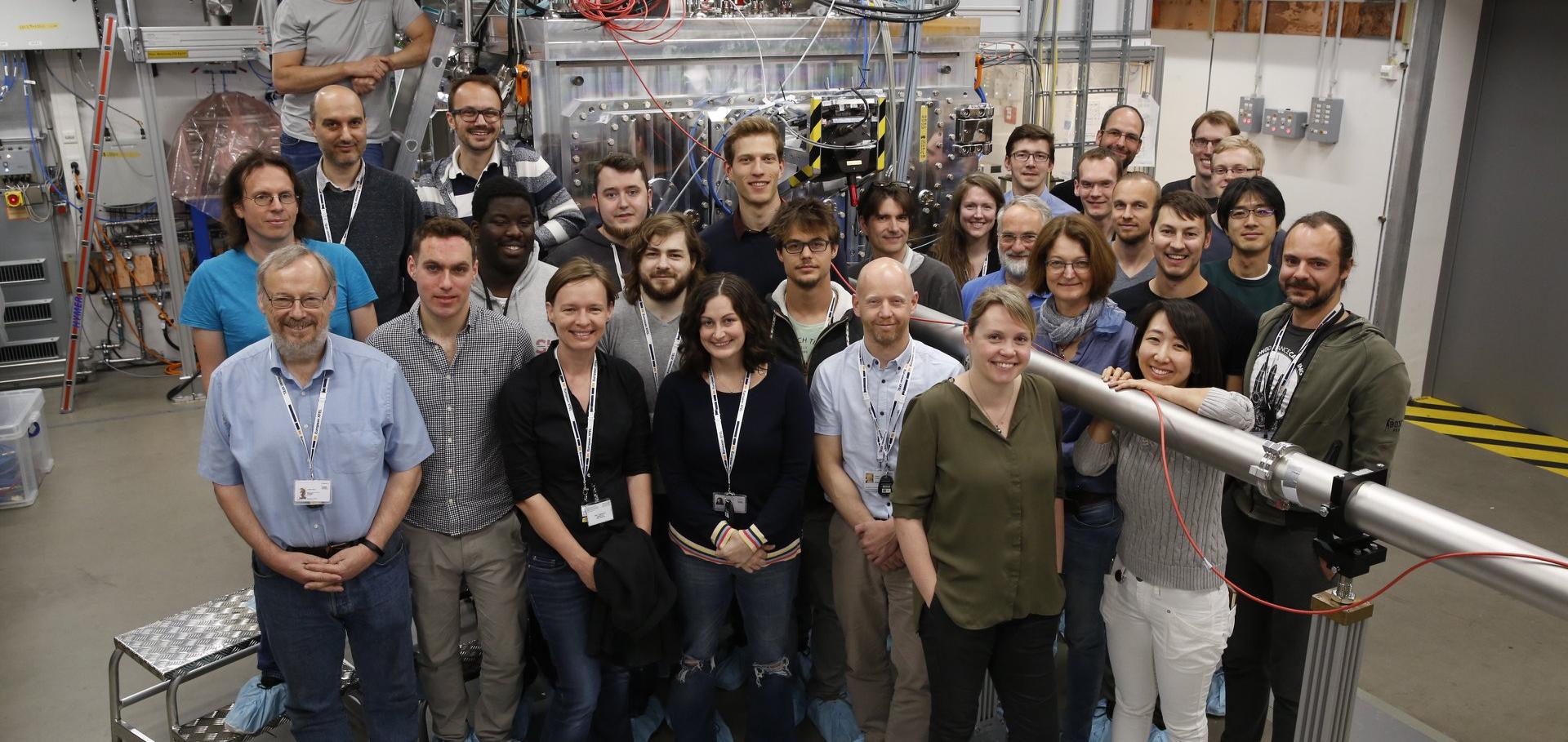
Shock compression experiments using the DiPOLE 100-X laser on the high energy density instrument at the European x-ray free electron laser: quantitative structural analysis of liquid Sn

Journal of Applied Physics AIP Publishing 135:16 (2024) 165902

Authors:

Mg Gorman, D McGonegle, Rf Smith, S Singh, T Jenkins, Rs McWilliams, B Albertazzi, Sj Ali, L Antonelli, Mr Armstrong, C Baehtz, Ob Ball, S Banerjee, Ab Belonoshko, A Benuzzi-Mounaix, Ca Bolme, V Bouffetier, R Briggs, K Buakor, T Butcher, S Di Dio Cafiso, V Cerantola, J Chantel, A Di Cicco, S Clarke, Al Coleman, J Collier, Gw Collins, Aj Comley, F Coppari, Te Cowan, G Cristoforetti, H Cynn, A Descamps, F Dorchies, Mj Duff, A Dwivedi, C Edwards, Jh Eggert, D Errandonea, G Fiquet, E Galtier, A Laso Garcia, H Ginestet, L Gizzi, A Gleason, S Goede, Jm Gonzalez, M Harmand, Nj Hartley

Abstract:

X-ray free electron laser (XFEL) sources coupled to high-power laser systems offer an avenue to study the structural dynamics of materials at extreme pressures and temperatures. The recent commissioning of the DiPOLE 100-X laser on the high energy density (HED) instrument at the European XFEL represents the state-of-the-art in combining x-ray diffraction with laser compression, allowing for compressed materials to be probed in unprecedented detail. Here, we report quantitative structural measurements of molten Sn compressed to 85(5) GPa and ∼ 3500 K. The capabilities of the HED instrument enable liquid density measurements with an uncertainty of ∼ 1 % at conditions which are extremely challenging to reach via static compression methods. We discuss best practices for conducting liquid diffraction dynamic compression experiments and the necessary intensity corrections which allow for accurate quantitative analysis. We also provide a polyimide ablation pressure vs input laser energy for the DiPOLE 100-X drive laser which will serve future users of the HED instrument.

Saturation of the compression of two interacting magnetic flux tubes evidenced in the laboratory

(2024)

Authors:

A Sladkov, C Fegan, W Yao, AFA Bott, SN Chen, H Ahmed, ED Filippov, R Lelièvre, P Martin, A McIlvenny, T Waltenspiel, P Antici, M Borghesi, S Pikuz, A Ciardi, E d'Humières, A Soloviev, M Starodubtsev, J Fuchs

Dielectronic satellite emission from a solid-density Mg plasma: relationship to models of ionisation potential depression

Physical Review E American Physical Society 109:4 (2024) 045204

Authors:

Gabriel Pérez-Callejo, Thomas Gawne, TR Preston, Patrick Hollebon, Sam Vinko, Steven Rose, Justin Wark

Abstract:

We report on experiments where solid-density Mg plasmas are created by heating with the focused output of the Linac Coherent Light Source x-ray free-electron laser. We study the K-shell emission from the helium- and lithium-like ions using Bragg crystal spectroscopy. Observation of the dielectronic satellites in lithium-like ions confirms that the M-shell electrons appear bound for these high charge states. An analysis of the intensity of these satellites indicates that when modeled with an atomic-kinetics code, the ionization potential depression model employed needs to produce depressions for these ions which lie between those predicted by the well known Stewart-Pyatt and Ecker-Kroll models. These results are largely consistent with recent density functional theory calculations.

Cosmic-ray confinement in radio bubbles by micromirrors

(2024)

Authors:

Robert J Ewart, Patrick Reichherzer, Archie FA Bott, Matthew W Kunz, Alexander A Schekochihin

Resonant excitation of plasma waves in a plasma channel

Physical Review Research American Physical Society 6:2 (2024) L022001

Authors:

Aimee Ross, James Chappell, John Van De Wetering, James Cowley, Emily Archer, Nicolas Bourgeois, L Corner, Dr Emerson, Linus Feder, Xj Gu, Oscar Jakobsson, H Jones, Alexander Picksley, L Reid, Wei-Ting Wang, Roman Walczak, Simon Hooker

Abstract:

We demonstrate resonant excitation of a plasma wave by a train of short laser pulses guided in a preformed plasma channel, for parameters relevant to a plasma-modulated plasma accelerator (P-MoPA). We show experimentally that a train of N≈10 short pulses, of total energy ∼1J, can be guided through 110mm long plasma channels with on-axis densities in the range 1017-1018cm-3. The spectrum of the transmitted train is found to be strongly red shifted when the plasma period is tuned to the intratrain pulse spacing. Numerical simulations are found to be in excellent agreement with the measurements and indicate that the resonantly excited plasma waves have an amplitude in the range 3-10GVm-1, corresponding to an accelerator stage energy gain of order 1GeV.