Home
Department Of Physics text logo
  • Research
    • Our research
    • Our research groups
    • Our research in action
    • Research funding support
    • Summer internships for undergraduates
  • Study
    • Undergraduates
    • Postgraduates
  • Engage
    • For alumni
    • For business
    • For schools
    • For the public
  • Support
Menu
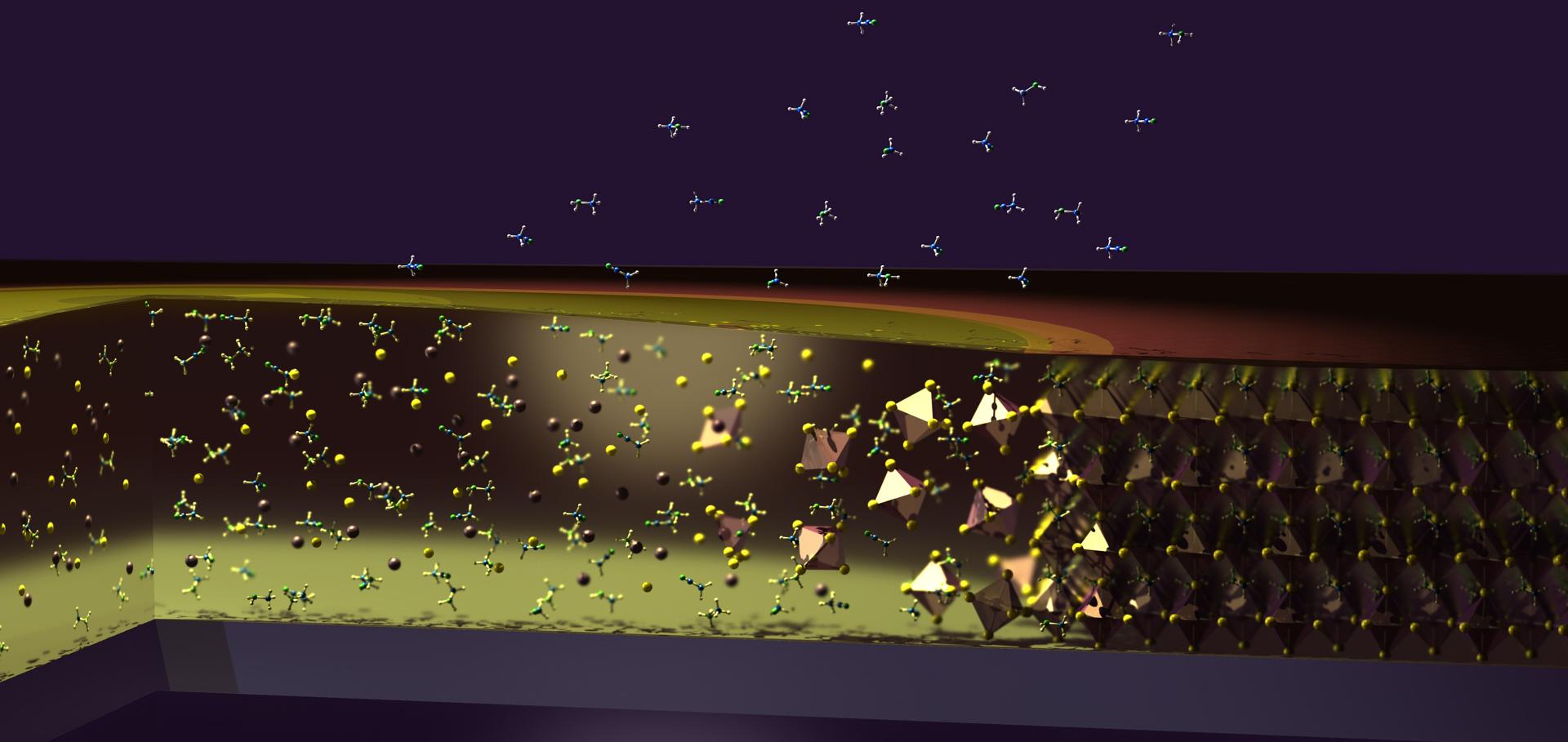
Perovskite crystallisation graphic

Nakita K Noel

Associate Professor and EPSRC Research Fellow

Research theme

  • Photovoltaics and nanoscience

Sub department

  • Condensed Matter Physics

Research groups

  • Novel Energy Materials and Advanced Characterisation
  • Advanced Device Concepts for Next-Generation Photovoltaics
nakita.noel@physics.ox.ac.uk
Telephone: 01865 (2)72401
Robert Hooke Building, room G20
  • About
  • Publications

Performance and stability enhancement of dye-sensitized and perovskite solar cells by Al doping of TiO2

Advanced Functional Materials 24:38 (2014) 6046-6055

Authors:

SK Pathak, SK Pathak, A Abate, P Ruckdeschel, B Roose, KC Gödel, Y Vaynzof, A Santhala, SI Watanabe, DJ Hollman, N Noel, A Sepe, U Wiesner, R Friend, HJ Snaith, U Steiner, U Steiner

Abstract:

© 2014 WILEY-VCH Verlag GmbH & Co. KGaA. Reversible photo-induced performance deterioration is observed in mesoporous TiO2-containing devices in an inert environment. This phenomenon is correlated with the activation of deep trap sites due to astoichiometry of the metal oxide. Interestingly, in air, these defects can be passivated by oxygen adsorption. These results show that the doping of TiO2with aluminium has a striking impact upon the density of sub-gap states and enhances the conductivity by orders of magnitude. Dye-sensitized and perovskite solar cells employing Al-doped TiO2have increased device efficiencies and significantly enhanced operational device stability in inert atmospheres. This performance and stability enhancement is attributed to the substitutional incorporation of Al in the anatase lattice, "permanently" passivating electronic trap sites in the bulk and at the surface of the TiO2.
More details from the publisher

Mesoporous TiO 2 single crystals delivering enhanced mobility and optoelectronic device performance

Nature 495:7440 (2013) 215-219

Authors:

EJW Crossland, N Noel, V Sivaram, T Leijtens, JA Alexander-Webber, HJ Snaith

Abstract:

Mesoporous ceramics and semiconductors enable low-cost solar power, solar fuel, (photo)catalyst and electrical energy storage technologies. State-of-the-art, printable high-surface-area electrodes are fabricated from thermally sintered pre-formed nanocrystals. Mesoporosity provides the desired highly accessible surfaces but many applications also demand long-range electronic connectivity and structural coherence. A mesoporous single-crystal (MSC) semiconductor can meet both criteria. Here we demonstrate a general synthetic method of growing semiconductor MSCs of anatase TiO 2 based on seeded nucleation and growth inside a mesoporous template immersed in a dilute reaction solution. We show that both isolated MSCs and ensembles incorporated into films have substantially higher conductivities and electron mobilities than does nanocrystalline TiO 2. Conventional nanocrystals, unlike MSCs, require in-film thermal sintering to reinforce electronic contact between particles, thus increasing fabrication cost, limiting the use of flexible substrates and precluding, for instance, multijunction solar cell processing. Using MSC films processed entirely below 150C, we have fabricated all-solid-state, low-temperature sensitized solar cells that have 7.3 per cent efficiency, the highest efficiency yet reported. These high-surface-area anatase single crystals will find application in many different technologies, and this generic synthetic strategy extends the possibility of mesoporous single-crystal growth to a range of functional ceramics and semiconductors. © 2013 Macmillan Publishers Limited. All rights reserved.
More details from the publisher

Mesoporous TiO2 single crystals delivering enhanced mobility and optoelectronic device performance

Nature Springer Nature 495:7440 (2013) 215-219

Authors:

Edward JW Crossland, Nakita Noel, Varun Sivaram, Tomas Leijtens, Jack A Alexander-Webber, Henry J Snaith
More details from the publisher
More details
More details

A green solvent system for templated sequential deposition of stable formamidinium lead triiodide for perovskite solar cells

Authors:

Henry Snaith, Benjamin Gallant, Philippe Holzhey, Karim Elmestekawy, James Ball, M Greyson Christoforo, Laura M Herz, Saqlain Choudhary, Joel Smith, Pietro Caprioglio, Igal Levine, Dominik Kubicki, Alexandra Sheader, Fengning Yang, Daniel Toolan, Rachel Kilbride, Karl-Augustin Zaininger, Nakita Noel
More details from the publisher
Details from ArXiV

Automation of Simultaneous 4DSTEM-EDX Acquisition and Data Analysis for Beam-sensitive Materials

ScienceOpen

Authors:

Jinseok Ryu, Alexandra A Sheader, Mohsen Danaie, David G Hopkinson, Katherine E MacArthur, Nakita K Noel, Christopher S Allen
More details from the publisher

Pagination

  • First page First
  • Previous page Prev
  • …
  • Page 7
  • Page 8
  • Page 9
  • Page 10
  • Page 11
  • Page 12
  • Page 13
  • Page 14
  • Current page 15

Footer Menu

  • Contact us
  • Giving to the Dept of Physics
  • Work with us
  • Media

User account menu

  • Log in

Follow us

FIND US

Clarendon Laboratory,

Parks Road,

Oxford,

OX1 3PU

CONTACT US

Tel: +44(0)1865272200

University of Oxfrod logo Department Of Physics text logo
IOP Juno Champion logo Athena Swan Silver Award logo

© University of Oxford - Department of Physics

Cookies | Privacy policy | Accessibility statement

Built by: Versantus

  • Home
  • Research
  • Study
  • Engage
  • Our people
  • News & Comment
  • Events
  • Our facilities & services
  • About us
  • Giving to Physics
  • Current students
  • Staff intranet