

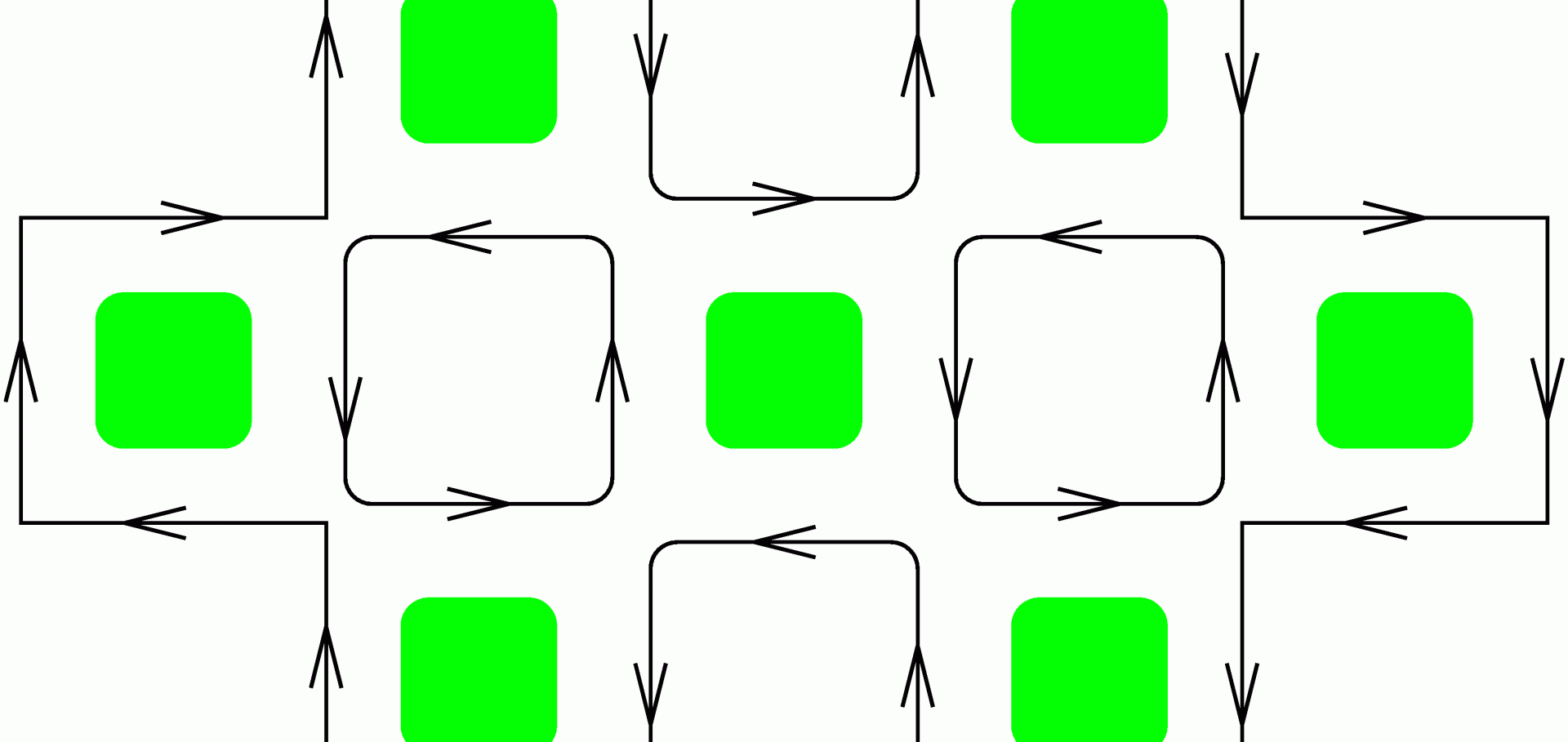
Viewpoint: Topological insulators turn a corner
Physics American Physical Society 10 (2017) 1-3
How SU(2)4 Anyons are Z3 Parafermions
SciPost Physics SciPost 3:6 (2017) 037
Abstract:
We consider the braid group representation which describes the non-abelian braiding statistics of the spin $1/2$ particle world lines of an SU(2)$_4$ Chern-Simons theory. Up to an abelian phase, this is the same as the non-Abelian statistics of the elementary quasiparticles of the $k=4$ Read-Rezayi quantum Hall state. We show that these braiding properties can be represented exactly using ${Z}_3$ parafermion operators.Thermalization and light cones in a model with weak integrability breaking
Physical Review B American Physical Society 94:24 (2017) 245117
Abstract:
We employ equation of motion techniques to study the non-equilibrium dynamics in a lattice model of weakly interacting spinless fermions. Our model provides a simple setting for analyzing the effects of weak integrability breaking perturbations on the time evolution after a quantum quench. We establish the accuracy of the method by comparing results at short and intermediate times to time-dependent density matrix renormalization group computations. For sufficiently weak integrability-breaking interactions we always observe prethermalization plateaux, where local observables relax to non-thermal values at intermediate time scales. At later times a crossover towards thermal behaviour sets in. We determine the associated time scale, which depends on the initial state, the band structure of the non-interacting theory, and the strength of the integrability breaking perturbation. Our method allows us to analyze in some detail the spreading of correlations and in particular the structure of the associated light cones in our model. We find that the interior and exterior of the light cone are separated by an intermediate region, the temporal width of which appears to scale with a universal power-law $t^{1/3}$.Multi-scale coarse-graining for the study of assembly pathways in DNA-brick self assembly
(2017)
Recoverable Information and Emergent Conservation Laws in Fracton Stabilizer Codes
(2017)