Periodicity and lattices

Chapter in Encyclopedia of Condensed Matter Physics, (2024) V5:17-V5:28

Authors:

JS Rutherford, AM Glazer

Abstract:

The notion of periodicity in crystals is examined and how this can be varied in practice. In particular, the article discusses first of all the concept of superstructures, in which some sort of alternating motif occurs thus changing the repeat distance in a lattice. Crystals of this type are often incorrectly called in the literature superlattices: first of all they cannot be called lattices at all as they consist of atoms (a lattice must only consist of points). In any case such a superstructure is formed from a sublattice rather than a superlattice. In addition, some crystals do not have normal periodicity within a three-dimensional space, and are known as aperiodic crystals. Despite being aperiodic, they are still ordered. In mathematical terms they can by described with respect to a higher-dimension space and then projected back onto three dimensions. This generalizes our notion of what is meant by a crystal.

The effects of solution processing methods on halide perovskite nanostructure

BIO Web of Conferences EDP Sciences 129 (2024) 24032

Authors:

Alexandra Sheader, Ryley Ratnasingham, Nakita Noel

Correction to “A Templating Approach to Controlling the Growth of Coevaporated Halide Perovskites”

ACS Energy Letters American Chemical Society (ACS) 8:11 (2023) 4714-4715

Authors:

Siyu Yan, Jay B Patel, Jae Eun Lee, Karim A Elmestekawy, Sinclair R Ratnasingham, Qimu Yuan, Laura M Herz, Nakita K Noel, Michael B Johnston

Roadmap on Photovoltaic Absorber Materials for Sustainable Energy Conversion

(2023)

Authors:

James C Blakesley, Ruy S Bonilla, Marina Freitag, Alex M Ganose, Nicola Gasparini, Pascal Kaienburg, George Koutsourakis, Jonathan D Major, Jenny Nelson, Nakita K Noel, Bart Roose, Jae Sung Yun, Simon Aliwell, Pietro P Altermatt, Tayebeh Ameri, Virgil Andrei, Ardalan Armin, Diego Bagnis, Jenny Baker, Hamish Beath, Mathieu Bellanger, Philippe Berrouard, Jochen Blumberger, Stuart A Boden, Hugo Bronstein, Matthew J Carnie, Chris Case, Fernando A Castro, Yi-Ming Chang, Elmer Chao, Tracey M Clarke, Graeme Cooke, Pablo Docampo, Ken Durose, James R Durrant, Marina R Filip, Richard H Friend, Jarvist M Frost, Elizabeth A Gibson, Alexander J Gillett, Pooja Goddard, Severin N Habisreutinger, Martin Heeney, Arthur D Hendsbee, Louise C Hirst, M Saiful Islam, KDG Imalka Jayawardena, Michael B Johnston, Matthias Kauer, Jeff Kettle, Ji-Seon Kim, Dan Lamb, David Lidzey, Jihoo Lim, Roderick MacKenzie, Nigel Mason, Iain McCulloch, Keith P McKenna, Sebastian B Meier, Paul Meredith, Graham Morse, John D Murphy, Chris Nicklin, Paloma Ortega-Arriaga, Thomas Osterberg, Jay B Patel, Anthony Peaker, Moritz Riede, Martyn Rush, James W Ryan, David O Scanlon, Peter J Skabara, Franky So, Henry J Snaith, Ludmilla Steier, Jarla Thiesbrummel, Alessandro Troisi, Craig Underwood, Karsten Walzer, Trystan Watson, J Michael Walls, Aron Walsh, Lucy D Whalley, Benedict Winchester, Samuel D Stranks, Robert LZ Hoye

A templating approach to controlling the growth of coevaporated halide perovskites

ACS Energy Letters American Chemical Society 8:10 (2023) 4008-4015

Authors:

Siyu Yan, Jay B Patel, Jae Eun Lee, Karim A Elmestekawy, Sinclair R Ratnasingham, Qimu Yuan, Laura M Herz, Nakita K Noel, Michael Johnston

Abstract:

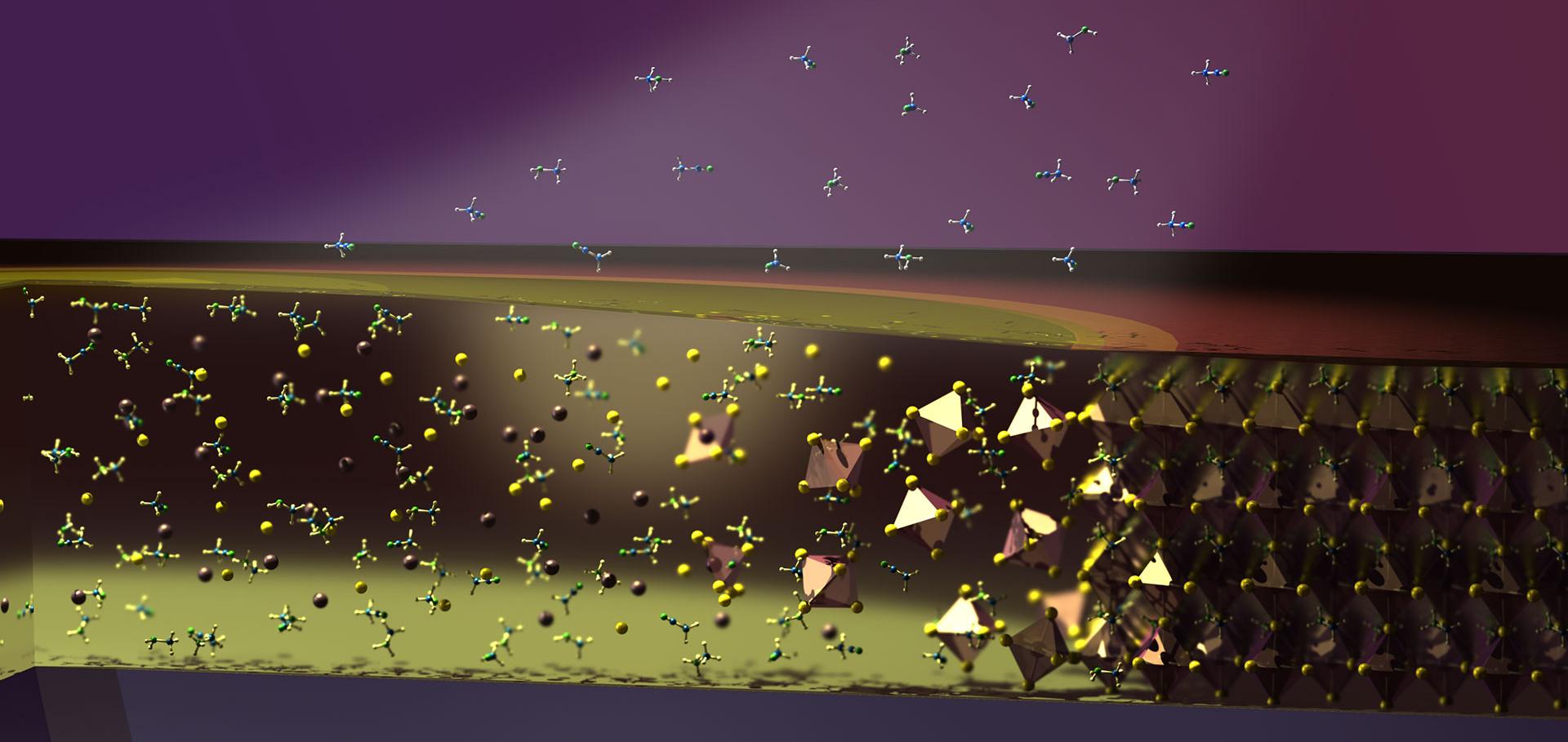
Metal halide perovskite semiconductors have shown significant potential for use in photovoltaic (PV) devices. While fabrication of perovskite thin films can be achieved through a variety of techniques, thermal vapor deposition is particularly promising, allowing for high-throughput fabrication. However, the ability to control the nucleation and growth of these materials, particularly at the charge-transport layer/perovskite interface, is critical to unlocking the full potential of vapor-deposited perovskite PV. In this study, we explore the use of a templating layer to control the growth of coevaporated perovskite films and find that such templating leads to highly oriented films with identical morphology, crystal structure, and optoelectronic properties independent of the underlying layers. Solar cells incorporating templated FA0.9Cs0.1PbI3–xClx show marked improvements with steady-state power conversion efficiency over 19.8%. Our findings provide a straightforward and reproducible method of controlling the charge-transport layer/coevaporated perovskite interface, further clearing the path toward large-scale fabrication of efficient PV devices.